Monday, June 16, 2008

Just Record it in Dubly


Digital Audio has been the both the savior and root of evil for the music business, truly the conversation has migrated from the back rooms of audiophiles and tech geek into the general zeitgeist.  


While today’s populist conversation centers on the question of downloading in the digital domain with the repercussions on intellectual rights and distribution models, there is a more overriding debate- which has existed since its beginnings.  The question is of Sound Quality.


I was an inside witness to recording studios transitioning from the old Analog Studer A-800 24 track machines to the Sony and Mitsubishi 48 track digital units.  I consider myself lucky to have been involved at this particular time as I learned the venerable process of syncing two 24 track Studers’ via a Timeline Lynx- a very hands on process.  I was taught by some of the ‘old timers’ still practicing the ‘art’ while becoming familiar with the new digital machines as well.  In short I was given the privilege of learning the method and process which the digital machines incorporated behind the scenes.  (I would also be lucky enough –in much the same way- to learn from a number of ‘ole’ slide guys the process and method of setting up multi-image shows. Working with these gentlemen helped me understand the fundamentals of media presentation and better understand how to deal with the –then- new media (meaning the medium) in video–(CRV, Mavica, DVD, etc) then pushing slides into extinction.


One of the earliest and most persistent criticisms of digital recordings is the ‘coldness’  in the sound for which all manner of outboard processing is used in final mix down to help alleviate. The processing is used ostensibly to add back in the ‘warmth’ that harmonic distortion of analog tape provides.  When I worked in recording studios the amount of gear that was used to ‘correct’ the coldness of a digital recording astounded me (still does). 


At the time Stephen St. Croix wrote about the failures of digital’s promise but eventually he came around to ‘embracing ‘it, I especially recall an article praising the newest version of Sony’s ATRAC compression scheme for the mini disk – (which came too late and directly after one of the early Sony disasters of which would become all too familiar later on).  I too came along slowly to the revolution in digital media but now embrace my iPod and streaming media. I also miss the days of high quality recordings that could blow you away from the first note.  I also worry my sons will not have the opportunity to hear great recordings as there will be no great recordings.


Now I know of several close associates who will (and have) argued that a high quality MP3 is possible and have provided me with recordings to prove their point.  The recordings are truly beautiful, but the mass market will never accept them- at least enough to have those who record them make any money back. I am sorry, but the dynamic path of change rules out all but the midland formats for mass market distribution. While it is true the digital format and (more importantly) the playback devices have become astoundingly better then products offered only few years ago; and the recorded quality has become noticeably better in the 20 years of digital, I have trepidations. My question is whether or not we have reached a leveling off as the amount of music being played, shared, transferred and sometimes even sold can support a higher grade format en masse.  A bigger question is if we have already witnessed the peak and are now at the top of a descending arc.


I write about this after listening to a podcast of T Bone Burnett on WNYC’s Sound Check where he rails against the current poor state of audio quality in today’s recordings by calling it


 “…a Xerox, of a Polaroid of a print of a painting….”


T Bone’s solution is to provide a number of formats on the DVD audio disc, so the listener can utilize the format of choice but have access to better if desired.


Mr. Burnett also makes a great point that listening to compressed digital audio is akin to


‘…hearing a Stradivarius through a hallmark card speaker.’


Two comments which left me nodding my head but he follows it up with another classic argument surrounding digital recordings, that of sample rate. T Bone restates the pet peeve of a number of recording engineers- that 44.1 KHz hobbles the quality of the recording from the get go.  Even with the Nyquist frequency I have had trouble seeing any benefit from setting the sample rate to 96 or 128Hz. Yes, the music played at the time of recording produced frequencies far above and below the human threshold.  As a musician Mr. Burnett is appalled that all this information is just cut out.  I on the other hand feel that the extraordinary recording (one that captures every nuance and harmonic resonance) will go completely unnoticed by 90% of listeners who do not and will never have the equipment to reproduce the sound properly.  Perhaps someday everyone will be able to own music systems which will give them true sound in every environment, but that day is a long time off. 


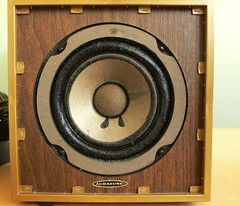
I applaud the fighting of the good fight but there is a reason nearly every studio control room has an auratone located dead center on the mixing board, to simulate the average home system.  The engineer can insure that the essential instrumentation comes through even in mono. Indeed we are setting the standard to never exclude the Lowest Common Denominator.


Friday, June 13, 2008

It's not *Hedy*, it's *Hedley*. Hedley Lamarr.


It's not *Hedy*, it's *Hedley*. Hedley Lamarr.


                    It's not *Hedy*, it's *Hedley*. Hedley Lamarr.


                                      It's not *Hedy*, it's *Hedley*. Hedley Lamarr.


It's not *Hedy*, it's *Hedley*. Hedley Lamarr.


                   It's not *Hedy*, it's *Hedley*. Hedley Lamarr.


It's not *Hedy*, it's *Hedley*. Hedley Lamarr.


Whether you know it or not, you use an invention of the 1940’s cinema star –(and ‘most beautiful woman in the world’) Heddy Lamarr every day, sometimes several.


The concept of spread spectrum frequency hopping had been conceived prior but none had applied in a useful manner.  Heddy and her associate, avant garde composer, George Antheil came up with the idea -(based on player piano rolls )- to help guide torpedoes and avoid jamming from enemy ships.


WNYC’s ‘The Take Away’ had an interesting article this morning about this and a play based on the unlikely duo’s contribution to the war effort called Frequency Hopping.


Alas their patented system was never used to defeat the Nazi’s but would be   ‘re-discovered’ by independent companies working on CDMA.  Every time you call on your cell you are paying homage to Heddy and Antheil – Now, do you think that I could find the Ballet Mecanique as a ring tone?


And Just because it makes me laugh:


Governor William J. Le Petomane: Thank you, Hedy, thank you
Hedley Lamarr: It's not *Hedy*, it's *Hedley*. Hedley Lamarr.
Governor William J. Le Petomane: What the hell are you worried about? This is 1874. You'll be able to sue *her*.


Aside:  I do seem to be on a Dadaist roll lately in my blog posting, not sure where this is going to go.


Thursday, June 12, 2008

Missed It by That Much

 Does WiMax already have its best days behind it?  The strained relationship between the IMT (International Mobile Telecommunications) and Sprint in its push to make WiMax the 4g standard may be all for naught.


Verizion  and Alltel announced a deal to combine their services and thereby trumping Sprints main goal for WiMax, long distance wide coverage and higher data rates then current 3G networks.


Verizion and Alltel have existing infrastructures which will allow them to quickly and nimbly outstrip the pace of installation by Sprint.


In attempt to ease manufacture adoption Sprint  and partners created an ‘open patent ‘group to


"…to help ensure product differentiation and interoperability at a more predictable cost


But one of the major 4G players –Qualcomm – is expressing indifference.


And what may be the equivalent of”Et tu, BruteNortel is shifting research funding from WiMax to LTE.


In addition there is  also the 60GHz band now under development for Wireless Personal Area Networks (WPAN) by the IEEE 80.11 study group on Very High Throughput (VHT) and the 802.153c group.  As the article as EE Times states


“The .3c group focused its standard on two applications. One is distribution of uncompressed high-definition video. The other is high-bandwidth synchronization of devices, such as wirelessly downloading a video from a kiosk to a portable media player.”


A direct strike at the other much touted possible use of WiMax. 


Sprint may invoked itself into a cone of silence


Tuesday, June 10, 2008

I Sing the Building Electric

David  Byrne has performed several exhibition pieces around the world by playing (and letting attendees play) buildings. The instrument consists of hooking up an organ keyboard to servos and motors attached  to the structures of buildings (columns, beams, radiators, etc) .  


David Byrne has more videos of the set up and performances on his website


 The sound is somewhat ambient, moves like dada, and has at its heart the early punk ethos –‘a musician could not play it any better a person off the street…’


Monday, June 9, 2008

Internet Radio is dead, long live internet radio.


I used to be what one could describe as a radio geek.  Living on the east end of Long Island your standard Realistic radio receiver would pick up signals from Connecticut, Rhode Island, NYC, New Jersey and sometimes ‘skips’ from as far away as Halifax  or  Harrisburg.  It helped that I lived on hill above town-one of the highest points in Sag Harbor.   I heard countless college and free form radio from all the listed above exposing me to the music and nomenclature of innumerable genres.  I built UHF amplifiers straight out of popular electronics or Radio Shack kits so I could tune in shows that I would not find locally.   I also nearly destroyed our families first VCR attempting to tap into its tuning section in an attempt to get better reception of WFMU.  You’ll recall that the early VCR’s used a series of tuning wheels to modulate the video out onto the TV channel – I learned so much by tinkering with it. Thankfully my mother never found out just how much I tinkered into that box, she would have been appalled at my opening such an expensive device.  In a very analog way I had my internet radio, just without the genre shaping Genome and Audioscrobble Pandora and Lastfm provide.  I pined for a shortwave receiver as I read articles about the stations in far flung parts of the world –or just the BBC- playing all sorts of music; alas I could never afford a decent one in high school.


I moved to NYC the summer high school ended and was both disappointed and intrigued.  Living on the top floor of a six floor walk up getting decent reception of WFMU, WSOU and a new find WNYU worked out fine with an ‘illegal’ antenna hook up on the roof. So I could hear the lone free form radio station much better and a new station came into my life which indeed opened my ears to the urban alternative rock movement. But that was it, aside from the few college stations or WBAI’s morning music-(I did love that Delphine Blue) broadcasting only at parts of the day- NYC radio was\is a wasteland.


This is why I fell so hard for early internet radio, it was brash, eclectic often shocking, sometimes dull and fidelity was a feature for a later date. It was just like to old days. Radio IO was my first and still my favorite.


Currently the number of internet ‘stations’ can be counted in the thousands but its mass cannot stop the rag tag collection from being washed out. Twice has published a report which shows internet radio is growing despite several forces which could in a perfect storm combine to wreck havoc like a tornado in a trailer park.  The article, based on findings from Soundexchange claims that the number of new stations registering with the Copyright Royalty Board (CRB) increased by 400, although this is 100 less than the numbers from last year.  My question is just who is applying and why. 


Some evidence can be gleaned from Warner Bros recent decisionto pull out of its involvement with Lastfm, most likely to put its eggs in the MySpace streaming project.  The issue? royalties of course.  Warner Bros has been quite vocal about its desire to siphon off a share of the Ad revenues, not just from the main page but from the ancillary pages a user may go to whilst searching the artist. This is not a bad thing as it shows a traditional brick n’ mortar music company actively looking to compensate for the woeful sales of physical discs.  I am sure if WB could effectively set up its own streaming ‘radio’ and abandon the distribution model it would.  A number of labels \ artists are utilizing a single point of sale model already as evidenced by the fact that  AC\DC is just the latest in a line of artist to sell their CDs’   exclusively through Wall Mart.


  Why would an artist\label apparently limit distribution and technically expose the product to less folks?  - Control of margins and less expenditure on real world distribution.   How long before Label (X) only provides a song via Pandora or only on its own site?  Madness you say? Just another example of last gasp attempts by a limping to extinction record companies?   Answer me this, why are most record labels (such as Warner Bros \ Time Warner) are against the legislating for Net Neutrality?   Bandwidth equals access.   If the ISP’s get their wish media companies could purchase the lion’s share of bandwidth and elbow out the smaller niche players by having the playing field all to themselves.     Some have argued that the hoopla is much ado about very little, that the shakeout will leave a number of marginal players absorbed or destroyed but that in the end the independent music will find a way to get out there.  I counter, imagine you own a building in which your business resides, then one day someone tells you that a bigger competitor needs 85% of your space for stock storage.   Oh yeah, and you will have to move your sign and front door to the back and the street will be reduced to a one way dead end.  You may still get some of your dedicated existing clients but most new visitors will not even notice you.  Bandwidth.


Over the next few years the big question for installers or custom systems is just how and what are you going to install in your clients homes.  Most certainly there will always be the high client who will want-(or told) the Media System with ADA output cards but where will the content come from and can you tag a recurring income from it?  Is the newest dealership to be an offical provider of Warner Bros licensed receivers?  Will high end CE manufacturers  provide multi license players much in the way you can sell ‘radio’ receivers with built in Wifi  for  internet content  streaming? 


Can pirate radio exist in a world where radio is only online? Will we never see the likes of Mark Hunter (Hard Harry)   again?


Thursday, June 5, 2008

My God it’s Full of Stars.


Just how does your space influence you?   NPR’s ‘On the Media ‘had an interesting show entitled ‘Space Odyssey’.


My industry is one of creating or enhancing the personal space of a corporation or home.  It’s simplistic and direct so this issue of OTM caught my attention immediately.   


Some regard personal space as a minimum of 3ft at any time (beware close talkers).   If you disagree, try living in NYC right after a major snow storm and navigating the barely cleared sidewalks.  Then talk to me about personal space.


Two sections of the ‘On the Media show’ felt particularly relevant. 


Clearing the Air


Discusses how San Paulo has banned all outdoor advertising, social issues it exposes and the apparent positive cultural effect this has had.


The article spurred some thoughts in me:


Love Piccadilly square but it can get a bit Enki Bilal or Blade runner.


I worked on an install at the Maiden Lane offices of TBWA\Chiat Day, creator of many Apple mac and the early wonder Bra ads. The company (the Chiat day portion)   had three floors of no offices- just wide open mobile work spaces, dramatic paint schemes, fire polls between floors- who needs’ stairs?  As well as a fantastic view of lower Manhattan and the meeting of the rivers.  I wanted to work for them right there.  The environment was perfectly suited to creativity, so much so that I wrote journal entries and poetry for each night I was there and weeks after.


It is interesting to note that the partner company TBWA was a strict black tie| white shirt culture, when they showed at Maiden Lane it became, well odd.


Sound Reasoning


Discusses the early 20’s research on how excess noise reduced productivity and the reactionary response of installing sound-proofing acoustic tiles- (they originally used the wonder product asbestos by the way).


 If you grew up or worked in studios during the early 80s you would still encounter some dead rooms. Dead rooms were popular from the late 50’ to the early 70’s where it was thought that a room devoid of any reflections or resonance was best for recording music.  My experience in these few remaining rooms was not quite unlike entering an anechoic chamber; for a young man who had the beginnings of tinnitus from too many roadhouse sessions behind the boards it was always a bit disturbing to have the ringing come from the background to front and center.


How many of us really understand the function ‘the space’ effects our interpretation of an event.  Acoustic, video and audio ‘sculptures’ clearly understand this and use subtle environmental queues to influence our reactions.   For the media this means branding via ads and viral campaigns  to associate image to feeling to sense of belonging .  For the Audio Visual industry it is about combining the elements of a physical environment toward a emotional result – usually excitement or relaxation or a mix of both.  


How often do you examine why you feel a certain way in a place, do you know who’s zooming who?


Saturday, May 31, 2008

Jack Butler: Yeah. 220... 221, whatever it takes


John Huntington of www.Controlgeek.net has posted a classic example of just how insane some of this industry can be. 


John posts a picture of a flyer from a 90's NSCA show of a product called the J-CON, a product which consists of an Edison socket connected directly to a 1\4" TRS plug. Yah.


You have to go and read the mind boggeling response from the Rep on the potential dangers. http://www.controlgeek.net/blog/2008/5/29/j-con-an-oldie-but-goodie.html


While your at it why not view a few more electrical horrors at http://www.ultimatehandyman.co.uk/forum1/more-electrical-horrors-t2444.html


Or check out the boys who build patneted devices to see if they could ever work. The Re-inventors http://www.history.ca/ontv/titledetails.aspx?titleid=103872


Friday, May 30, 2008

I mean, we'd be as rich as the Stones if only we'd sold as many records as them.


Does digital media need a centralized distribution model?


For generations the large record companies not only offered access to the means of recording but more importantly to the vast distribution chain that put records into stores and on the radio. Napster added gasoline to an already smoldering fire. Just like the time your uncle Ron poured half a can of lighter fluid onto the charcoal grill, the resulting flare up took off more than a few eyebrows but should not have surprised anyone watching.


I recall seeing the circa 1999 and 2000 interviews with Chuck D of Public Enemy declaring the age of the major labels to be nigh. The promise, according to CD was of a limitless variety of music all directly from the artist at half the cost – if not free.  He got it right, the revolution is being downloaded. But just where do I find all these artists? How do I find what I want and get involved with other artists who may share similar genre? In many ways it has been a piecemeal process to find new music outside the standard web portal stores. (It is interesting to note the number of artists who recanted support once it was their music being ‘shared’ for free).


Sure, there is\was MySpace which started out a place for musicians to stake out a place on the web to directly connect with fans and build followings out of local shows. This network of fans could connect in this early version of a social network site to share their thoughts on the newest songs, the show last night and find others going to a local show. Prior to this fans of marginal or indie bands often communicated and ‘gathered’ via pen pal groups or through the pages of fanzines like Maximum Rock n’ Roll. MySapce provides some means of selling hard copies or downloads but unless the band page linked to other bands your ability to find new music was limited to what the labels put out or fans called out in the chat boards. In essence you had know where to go,  to go.


Today we have ‘intelligent’ streaming players who learn what your likes are and can build playlist(s) of ‘related bands’ based on your input – Pandora has the Genome, Last.fm has Audioscrobbler-(all provide links to purchase single MP3s or albums)..  Facebook provides the ability to give visitor’s music links and streaming video of the bands you like-(and purchase links). Bloggers can embed tools like StreamPad to share your favorite music. While the number of collective sites is growing, all are still struggling to stand out amongst the haze of information. Each has its set of fans who evangelize promises of providing the most comprehensive access through links and social networking. Even Amazon has long attempted provide outreach based on the ‘others who purchased ‘x’ also purchased….(Y & Z). In Truth none of these stand out clearly above all others.


iTunes has similar micro models like this but it is just a distribution point and not a label or content producer… yet. The record companies have only begrudgingly joined forces with Apple because it was the first model to provide some legal and protected means of establishing a foothold where the pirates reigned.  And for the most part it is still a lonely outpost of mainstream music sales. The labels have long bemoaned the margins provided by Apple and have fought – unsuccessfully – to pry more out of iTunes and to get a rise in prices.   


Ian Rogers at FISTFULAYEN has proposed an interesting restructuring which he hinges nothing less than the survival of labels.  IR’s proposal in a nut shell is to utilize the mature power tools of record companies, mainly –distribution, marketing as well as A&R. One large label would be broken down in to smaller outfits that focus on specific markets \ genres. The micro labels could develop larger market bands on which dozens or hundreds of like genre – (or cross gene)- bands could be hung or cross referenced upon.  Add in a centralized payment utility and any label could begin to compete with the market share iTunes has.


It could also shift a measure of control back to the suits. When we finally enter into a post net neutrality world, this power shift could mean influence on traffic and bandwidth toward their favor.  


But is it really necessary?  Can the decentralized direct artist to fan model provide an adequate income to survive if not flourish. In other words, is there a way provide income where a day job is not necessary?


Kevin Kelly seems to think so.  Mr. Kelly discusses the concept of ‘1000 True Fans’  on, one of his several blogs, the Technium http://www.kk.org/thetechnium/archives/2008/03/1000_true_fans.php.  The basic concept is one where  an artist can make a comfortable living by tending to a 1000 fans who are dedicated to buying the music, subscribing to the blogs \fan club, buying the T-shirts and going to the shows. To earn a base income of $100,000 it would only take each True Fan spending $100 a year, which is a very manageable number. The gross number does not take into account overhead of servers, ISP and equipment but it is still a workable model.  Mr. Kelly also addresses this in his entry ‘The Case against 1000 True Fans’.   The main argument being that many are not looking to just survive but to sell platinum numbers of units. I have begun to believe that such aspirations immense rock n’ roll wealth are to be relegated to the stories of yore. As Gene Simmons so emphatically stated during his conversation on the Henry Rollins Show (IFC) ‘…its over, the industry has been killed by you (points at screen) downloading illegal copies of music… There are no more rock stars…”.


Having subscribed to Indie fanzines such as The Big TakeOver for years I tend to concur with the tongue, It is the niche market indie bands who will find solid ground of continued production and income, just not millions of dollars a year. Regardless it is now possible for artist to ‘live off the grid’ of major labels –or any label at all.


.


Thursday, May 29, 2008

Now, the making of a good compilation tape is a very subtle art. Many do's and don'ts. First of all you're using someone else's poetry to express how you feel. This is a delicate thing

 If you are old school like me and still long for the days of mix tapes the site MuxTape is for you.


I have a certain amount of nostalgia for the creating a seamless tape of songs which were more then a jumbled together collection but had intent and purpose, ('a tape for Laura - her songs', 'the madness of living on 12th street').  The act of creating an analog mix tape is an art lost in the playlist era.  It is not that the thought process for creating the order of songs is any less, but the ease of building a list with drag and drop lacks the 'hands on effort' once required to operate multiple decks.


Mux Tape is nifty in that it attempts to give off the aura of old mix tape experience. It has a clunky interface, where you choose a list names which are set up as if you were digging through a cassette organizer looking at the cover labels.. Just like an old analog tape you can get the 'tape' but only know whats on the tape \ playlist by opening it. As an added fun the tape names are never in the same place when you get back to the main page - just like when your roommates took tapes and put them back wrong!


 Up until a few days ago a Muxtape user developed a search engine at muxfind.com which allowed searches of artist or song title. I loved the tool as I could find playlists with a band I desired then get to hear someone else’s take on what other songs work around it.  Unfortunately it appears the fear of the RIAA has gripped muxfind and they have pulled back the Song \ Artist search feature and offer only the URL or Playlist name search. 


While is a free steaming music site, Muxtape.com does not conflict with my previous entry the effects of freevirus as muxtape offers link for each song for purchase. via an Amazon link through. While the RIAA might get all hot n' bothered - me not so much.


Wednesday, May 28, 2008

When the bomb goes off there'll be a thousand mutations! Andromeda will spread everywhere! They'll never be rid of it!

Jesse James -( the custom motorcycle maker, not the 1800's outlaw)- has a tattoo on the palm of his hand which reads 'Pay up Sucker' around a $100 bill. Why? because even in his small specialized client base there are people who want his services for free. When viewed from the perspective of individual businesses against an industry the effect appears insignificant, take a macro view and free can be a killer.  Philippe Bradley  (who writes in sheer genius form) made me aware of the 'freevirus' concept in a post on Fred Wilsons blog  in a post entitled "Triangulating For Insight"


Using Darwinian evolution as a metaphor for Venture Capitalists’ role in developing startup companies, Mr Bradley introduces the concept Freevirus coming about when startups who have a building subscriber base get attacked and usually destroyed by 'competing' services who offer free what the startup charged for. Once the virus is let loose it usually takes down all around it and in fairly short order begins to run out of hosts.  If a freevirus upstart manages to destroy or weaken the original hosts it must find something to sustain it - usually ads. The end result is less choice as the startups who had financial backing and an economic model for sustainability and innovation are killed off and the FV upstarts are thinned due to lack of sustainability.  (I cannot do the original post justice you must go read it).


And yet, it is the freevirus's action which brings in the mass market acceptance, draws in those beyond first adapters. As a service transitions from niche tool of the uber chic to general ubiquity the freevirus version suffers through the invigoration and stresses of meeting the demands and criticisms of users.  New tools are developed and added as suggestions and demands are stated. So, freevirus can often act in a symbiotic manner - for a short time. As my wife is fond of stating, "Oh Honey, nothing really comes for free...". 


Can freevirus be harnessed into a benign catalyst? Prior and current examples are inconclusive,


Microsoft floated the idea for a way to prop up the struggling Zune platform, with the expected backlash.


No Ads on my Zune please:


http://news.cnet.com/8301-13526_3-9948849-27.html


.
One model is to provide services or content which the freevirus cannot match or have available.


Frustrating the Pirates:


http://www.nytimes.com/2008/05/17/technology/17online.html?partner=rssnyt&emc=rss


.


What does it mean when even the uber techies -(many of them VC's who struggle with this question)- balk at paying for the much heralded Twitter?


Will the Tweets pay for their Tweets? Nope.


http://news.cnet.com/8301-13505_3-9950085-16.html


Even large infrastructures cannot find the funding to keep subsidized toplogies up and running.


Say goodbye to Muni-Fi


http://www.infoworld.com/news/feeds/08/05/16/Say-goodbye-to-Muni-Fi.html


Why are we so averse to advertising which can subsidize content, keeping the cost low or free?   The legitimate Question of whether advertisers could have any direct control of content is a serious one. (No more clear channels please!).


 Why do so many insist that all content should be their right not a privilege to obtain?   


Why are you a freevirus carrier ?


Saturday, May 17, 2008

"When properly lit and shot on film, this makes for the best test of flesh tones one can find." -TW

It is indeed interesting what one finds whilst trolling manufactures websites – Yeah, I know I need to get out more.


3M has announced a functioning video projector designed to fit into a mobile device (Cell Phone, Blackberry, and Digital Camera).  The 3M site http://www.3m.com/mpro/index.html states the unit is


"Roughly the size of a wireless earpiece, and a half inch thick..."


can project an image of


"VGA 640x480 Resolution"


And - most interestingly or curiously


"Projects sizes 5' to 50' or more"


The 3M description markets this as a social tool for sharing photos and videos; I see the break mobile content providers have been looking for in particular the WiMax folks.  All those arguments against people watching content on their phones because the screen is too small just may have gone away. 


Taking a futurist POV, imagine a time when there are no 103" plasmas just your mobile content device which projects an HD image of up to 60" or 70".  Aside from a central sever for storing your terabytes of content you take it all with you. (that which you could not store on the mobile device could be accessed via a slingbox like connection) oh, and it can make phone calls as well.


While the techie in me gets all worked up about the above being possible and I am intent on finding system diagrams to figure out how this works, the luddite in me bemoans the loss of regionalization. With the advent of cable, Satellite TV and the Slingbox type devices we no longer allow ourselves a chance to see local programming. Often locals do not see local programming - aside from the 6:00 news. Accents are becoming homogenized, Story lines all the same. Instead we arrive at the hotel, set up our PC to connect to the Slingbox and watch all our shows including our local news-(not the local news of the place we are staying). I do have hope that IPTV and sites like YouTube will always provide an outlet for truly regional culture; does anyone know exactly what happened to the Manhattan accent you last saw in 40's movies?


There are a number of troublesome possibilities as well:


·       Those lovely folks who seem to think the rest of us are utterly fascinated with their lives and use their Nextel or speaker phone on trains have a new way to invade personal space.


·       The potential for showing images you would really not rather- or I'd rather not see.


The lure of showing something elicits in a public manner -even if just as a laugh- can be quite strong.


In the days of the first single gun LCD projectors a number of techs-(including me) and a projectionist stayed late putting a new unit through its paces. The company I worked for rented several floors which had windows on two side streets and the main ave. Initially we pointed the projector out one of the open windows facing a block long side street wall to see just how big an image the projector could actually produce.  The image was big and damn bright! As it grew later on an early summers day we became even more impressed as the video engineer tweaked a few things and was able to produce a super bright image of about 20' (remember the throw was just a Manhattan side street width).  The projectionist wondered aloud if this 'data' projector could moonlight as IMAG support - (IMAG commonly is the projected talking head of the on stage speaker).  Someone mentioned that it must be fairly inefficient in handling flesh tones. 


Here is where the title of this entry comes from. Our ever resourceful projectionist placed a tape in the SVO deck and hit play. Up before us leaped to life a 20' super bright image of a couple in flagrante delicto. Yeah, you read that right.  There in full color was a 20' porn playing. We laughed, snickered, and thanked our stars that this was an industrial area after 8 pm on a Tuesday night. Then we heard a Yelp, expletives and our desk phones started to ring.  It appears two senior management types had stayed late as well and were just at that moment crossing the side street when our impromptu show had started.  Suffice it to say, the next few days were a bit tense in the office. Those who know the story, who’s initial are credited to the quote and just why we had ready access to the content will completely understand why I still find it hilarious.


We were some high tech geeks with access to very pricey toys and took a moment to misuse it. It was a one off event unlikely to happen again for some time.  Now anyone with a penchant to cause a ruckus could do nearly the same but all from his \ her mobile device.


Considering the two leading specs quoted above from the 3M site. 


640x480 is just tolerable looking at a 5' image, any bigger and you lose all definition.  I see no way the "..up to and above 50' image" is plausible.


Friday, May 2, 2008

This Way to the Egress

Just as the doomsday clock on the cover of  'Atomic Scientist' magazine indicates the proximity to the precipice so the reports of shenanigans in HD retail indicate the level of desperation of those to be 'left behind'.  The deceptions, bait and switches and out right lies are everywhere waiting to lure in the innocent and uninitiated.


The 10 worst HDTV, scams, lies and ripoffs.


http://hdguru.com/the-10-worst-hdtv-scams-lies-and-video-ripoffs/


This article does have some faults, in particular a general misunderstanding of HDMI and the rules of HDCP but is right on with Fake HD Cable and Satellite Channels (number 9) and Deep Color (part of the 1.3 spec and number 7 on the list).   


Deep color is currently nothing more then hype and promise with no source devices capable of producing deep color content.  Yes, you will be ready when and IF this is ever utilized by content producers, yet as Pee Wee Herman said- 'You have a big but there...'


Fake HD channels are just dishonest, yet every cable and satellite provider has a few channels they include in their HD package which are in reality SD widescreen content.  Phil Swann of  www.TVPredictions.com  has commented on this at


HDTV: Networks Should Stop Stretching the Truth


http://www.tvpredictions.com/forum/comments.php?y=08&m=04&entry=entry080421-102055


Why would major broadcast and cable providers deliberately try to fool the average HD viewer? Because 


1. The true HD content is STILL not there. Well at least in the volume to feed a constant broadcast schedule.


2. Cable and Satellite providers have a serious issue of bandwidth. Consumers are demanding two main services, HD content and a plethora of choices. Without compressing the digital data - thus losing some detail- it is just not possible for these providers to deliver both true HD content and 1000 channels. (Thus proving Bruce Springsteen was right all along). 


MSNBC provided an interesting article on this subject:


Cable TV under fire for degrading HD quality


http://www.msnbc.msn.com/id/24238071/


The Slashdot folks also took Comcast to task on this


http://slashdot.org/article.pl?sid=08/03/30/2113218&from=rss


And that promise of 1080p? All those sets selling by prominently listing a 1080p capable spec, well your going to have to wait awhile


Tandberg CEO: 1080p HDTV In 3 Years


http://www.tvpredictions.com/1080p041408.htm


Still think this is just a few over eager manufacturers jostling for market presence?  Um, not so much, major retailers are trying to dump non HD units on unsuspecting consumers:


Retailers Fined $4M for Improper Labels on TVs


http://www.npr.org/templates/story/story.php?storyId=89551875&ft=1&f=1019


Then there are the stacks of portable TV these same retailers are still selling with no warning that in only few short months they will be as useless as wax cylinders.


Don't buy a portable TV this year


http://www.news.com/8301-10784_3-9911621-7.html?part=rss&subj=news&tag=2547-1_3-0-20


There is also the very real possibility that millions will be left without any form of TV reception and no, we are not just talking about those living in the vast stretches of Montana- NYC and

Boston

top the list:


Study: 9.2M Homes May Face Digital TV Outages


http://www.tvpredictions.com/centris041008.htm


Into this possible gap comes the federal government and its DTV coupon program to help those of lesser incomes purchase converter boxes at discount -(and thus extend the life of their non HD\DTV sets). All is well you think, Ha!


Scammers Exploit DTV Coupon Program


http://tech.slashdot.org/article.pl?sid=08/04/08/2245248&from=rss


The title of this post comes from the semi anecdotal story about PT Barnum’s infamous '

American

Museum

'. The premise of the story is that the museum was so popular that folks would linger too long, thereby making it difficult to get others in and impacting the total days take. P.T being the shrewd showman posted signs throughout the museum which read 'This Way to the Egress!', knowing full well most people would not know that Egress meant exit. It is said that many a visitor would follow the signs out a door and down a covered stairway to an empty courtyard. The door just exited closed and locked behind them, thus making another ticket charge the only way to get back in.  Many people would complain that they never did get to see the Egress!


Wednesday, April 16, 2008

Heisenberg Exits Forthwith, Whereabouts Uncertain

There are many dimensions to our universe, some say it is fixed at 4 or 5, others state a 12 dimensional universe actually makes the math in a grand unified theory nearly work.  A good entry level book on this subject is Hyperspace by Dr. Michio Kaku - http://www.amazon.com/Hyperspace-Scientific-Odyssey-Parallel-Universes/dp/0385477058 .


Space and Time are funny things, interrelated and so very separate. Into this fray comes the company Alien which has announced a product which can tell the speed and location of a tagged item. The article


RFID reader can now identify velocity, position of tags


http://www.news.com/8301-10784_3-9917346-7.html?part=rss&subj=news&tag=2547-1_3-0-20


discusses possible uses for airport and military cargo. I see the possibility of using this technology for environment automation. Many green initiatives require occupancy sensing to minimize energy use in unused rooms. Most of these 'people counters' are microwave sensors which only indicate movement or,when mounted to a door frame, numbers in and out of a room. This is a highly inefficient method as the timing between sensing a presence and sensing no presence is awkwardly long.  Imagine using this Alien RFID product to sense presence, speed of the person and by extension direction - to intelligently decide just how bright to make each room traveled through and prepare the next room to be entered.   This is a much more efficient method where the lights are kept on only to ensure an individual can see enough to travel through safely, no time delay.  This is only one possible application, silly versions can have doors open slower or faster depending on your travel speed - thus helping avoid a crash into a half open\closed door.


Now, does this make the   CERN ATLAS particle accelerator  unneeded?


Thursday, April 10, 2008

HDMI - Nitrate Free?

HDMI is a funny thing. To those of  who cut our teeth crimping copper BNC or soldering XLR's trusting in a cable we cannot make ourselves presents a quandary.   The first time I looked into an HDMI cable I was left with questions similar to those often asked about hot dogs - 'Just what is in that thing?'.


A number of questions still befuddle installers daily


  • How long can I run an HDMI cable -(answer: it depends on the gauge and quality of cable not necessarily a predefined length limit)
  • What effect does HDCP have on my connections -( answer: its presence turns off component outputs  \ inputs and does have bandwidth considerations, which may effect usable cable length).
  • Which devices support deep color ? -(a few, maybe).


In an apparent answer to our questions I have been receiving a plethora of newsletter and articles on just such subjects  lately:


CEpro: 3 ways to improve HDMI http://www.cepro.com/article/3_ways_to_improve_hdmi/?utm_source=CEPWeekly&utm_medium=email


HDMI.org newletter: What do speed ratings on HDMI cables mean? http://hosted.verticalresponse.com/170134/ceb1d060a1/132000973/9ac1526c60/


HDMI.org also has a great  set of  webinars (live or self guided)http://hdmi.org/learningcenter/installer_training.aspx


Deciphering the Mystery of HDCP and HDMI http://www.rentalandstaging.com/articles/publish/article_1054.shtml


How HDMI works from Howstuffworks Daily feed: http://electronics.howstuffworks.com/hdmi1.htm


The Nuts and blots of HDCP by Crestron's own Rob Carter. http://www.digitaltvdesignline.com/howto/showArticle.jhtml?articleID=206800378


Now can anyone tell me just why hot dogs have 10 to a pack but the buns only have 8?


Perhaps Cecil can http://www.straightdope.com/classics/a2_350.html


Friday, April 4, 2008

MMMMMax Head- HeadRoom? No, its WiMax -Stutter Optional.

Those who have been long time readers of this blog will know my fascination with Sprint's WiMax plans.  True mobile broadband has remarkable potential not just for content on the go but to provide seamless content which can travel from mobile to home theater with the click of a docking station.


Sprint had some issues garnering any real productive support from partnerships, all while declaring WiMax a true 4G mobile standard.  The declaration irked the wireless telecom industry standards organization who would only comment that WiMax was to be viewed as a building block not and end unto itself for 4G.


Then the news stalled for awhile.


In the last week or so a number of article have started to show a revised plan and possible industry support.  There is also talk of spinning off the WiMax into a separate company. 


On the positive side there is the showing of a WiMax enabled Tablet PC from Nokia -(due out this summer)


Nokia Tablet to Use Sprint WiMax Network


http://www.nytimes.com/aponline/technology/AP-Wireless-Show-WiMax.html?ex=1364875200&en=fc218dd7d0ea2e58&ei=5088&partner=rssnyt&emc=rss


Then there are the partnerships, however limited - Comcast in is $1 billion while TW is at $500 million-which are viable as they have a great deal to gain if the plan is a success. 


Comcast and Time Warner to Bankroll WiMax Joint Venture


http://www.news.com/8301-10784_3-9903411-7.html?part=rss&subj=news&tag=2547-1_3-0-20


Cable company interest may not be the first entities one would think to partner with a wireless phone system but further thought shows it to be a great tactical move if it succeeds.  Phone and Cable companies have been making in roads into the others main market for the last few years-(cable offering VoIP while phone companies now offer cable like media content on their land lines).  Cable companies see WiMax -(as well as the 700MHz band just sold off and the 'White Spaces' proposals) as taking the fight back to the wired Telecoms.  The hope is to establish WiMax into what the now failed Muni-Fi system promised but failed to deliver though less then stellar data rates and some community resistance.  On its face WiMax broadband opens the market for a host of devices -iphone like- whose central function is Internet access with voice as a secondary feature. What has only been hinted at is the ability to use this backbone to provide real-time video services; this is what the cable companies want.   Imagine having access to the baseball game whilst on the bus, subway or at the Cafe.  Add to this the ability to pull up Internet for stats, twitter chats or your fantasy baseball team progress, all at wired broadband speed.  In a cradle to grave metaphor the WiMax partners envision you taking this real time content all the way home and continuing to use their service as your primary content provider.  In a system concept similar to wireless video and the 802.11n standard, the hope is for the user to take their WiMax device and connect it to a monitor when home - never missing moment of the show and never having to switch to a land line provider.


And then the realities of rolling an actual system\devices brings us back to the daily grind:


Sprint Delays WiMax Roll-out, Again


http://blog.wired.com/business/2008/04/sprints-xohm-de.htm


Plans are now for a summer 08 roll out but by delaying the commercial start this will allow for the hype generated by AT&T and Verizon to begin to influence corporate planners.


If any thing the WiMax concept and Mobile broadband interest rides along side the rise in demand  for mobile video content. I have long stated the Phil Swann Inverse Square Rule, Every time Mr. Swann -or someone on on his TV predictions forum- wonder aloud why anyone would want to view content on their iPhone type screens; the number of  consumers clamoring for it doubles.


Tuesday, April 1, 2008

Eh?! Whats that you say? It sounds like a barking dog, or Caruso Singing. I am not quite sure.

So, I get this new found energy and desire to re- start up the blog, and things are going well.  Then BANG I catch the nasty cold that has been making the rounds between my 2 1/2 year old, my 9 month old and my Wife.  I am a bit bleary eyed and my nose is running like a leaky spout. 'I love it when a plan comes together'.


While my biting repartee is muted I did find some interesting items of  Tech Arcane -(dammit, I still cannot get the Jerry Reed song  'East Bound and Down' '...cause the boys are thirsty in Atlanta and there's beer in texarcana',  song outta my head).  What this really shows is that I watched the first Smokey and the Bandit movie way too many times as a kid. SATB may very well be where I caught a hook into the then 'hillbilly sounds' of country. I soon found better refuge in the likes of Hank Williams.  Then Rock n' Roll took hold O' my soul, but of the pure guitar pickin and twangy harmonies made their way back to me in the likes of X, Wilco, Lucero and the Rock-a-Billy \ Punk-a- Billy of The Cramps, The Reverend Horton Heat, Slick Pelt  and garage -billy bands like the Stumbleweeds.   Technologically we live in gilded age of musical access where many of us only have the slightest inkling as to where it all started.


Edison is heralded by the mass culture as the inventor of recording.  He certainly had his hand in making a mass market device which allowed for the music to come to you rather then having to go out and see it live. (it is interesting to read archival articles on how stunning people thought the sound was, how true to life , and also to hear the naysayers declare it did no justice to being in the music hall to hear first hand.   The modern equivalents have allowed us mock the over reaching comments of yesteryear but in reality our grandchildren will say the same of us).  Yet, Edison apparently is not the first to conceive of and operate a recording device.  I found  an interesting article on the NPR site about  much earlier French devices which only recently could be listened to.  The article describes and has an audio sample of an 1857 recording of a French folk song:


Sound Recording Predates Edison Phonograph


http://www.npr.org/templates/story/story.php?storyId=89148959&ft=1&f=1019


I also found a nifty little article and video of a Japanese learning toy manufacture who made a limited quantity of Edison phonograph toys.  The Toy will record and playback from a standard plastic cup:


Plastic Cup Gramophone Kit: Edison Reproduced


http://gizmodo.com/373307/plastic-cup-gramophone-kit-edisons-invention-reproduced